You stuck to the list, you skipped the extras, and the total at the register still came out higher than you expected. And the kids still need snacks for the week.
Here’s the short answer on how to save money on groceries: plan before you go, pay for food by the unit instead of by the package, and throw less of it away. Prices are rising more slowly than in past years (food at home was up 1.8% over the 12 months to September 2026, according to the BLS). But USDA expects beef and veal to cost 9.4% more in 2026 (ERS forecast, updated Sept 25, 2026), so what you buy matters as much as where you buy it.
Below are 25 tips in the order you’ll use them: before you shop, at the store, at home and in the lunch box. Saving on takeout and restaurants is its own topic, so this post sticks to food you buy and cook at home.
How to save money on groceries before you shop: 8 tips
The easiest ways to save money on groceries happen at the kitchen table, before you leave the house. You can do this whole group tonight.
1. Know your weekly grocery number
Take the money you have for groceries this month and divide it by the number of weeks you’ll shop. That’s this week’s number, and it’s the one to beat.
No grocery line in your budget yet? Start with our guide on how to budget for beginners.
For a reference point only: USDA’s Thrifty Food Plan puts a family of four (two adults, kids aged 6 to 8 and 9 to 11) at $236.30 a week, or $1,024.00 a month, as of September 2026 prices (report issued October 2026). It assumes every meal and snack is made at home.
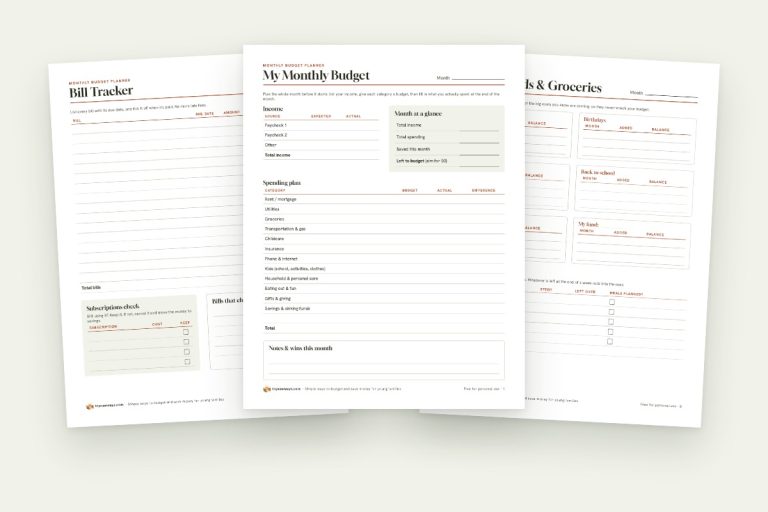
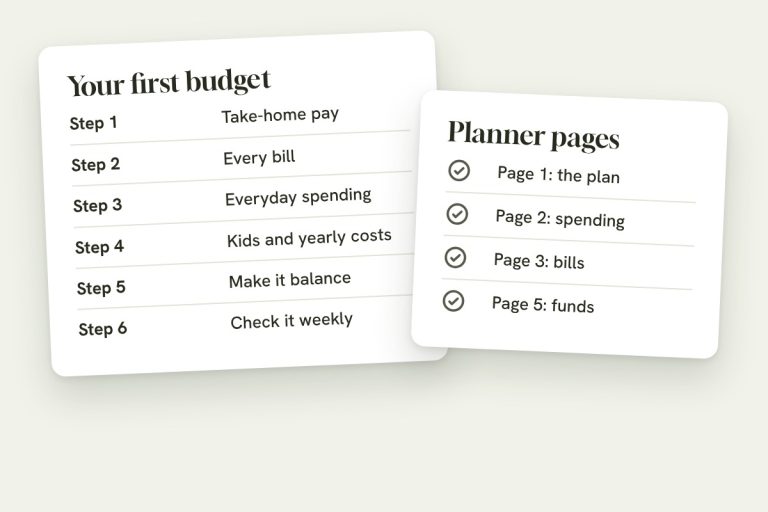
Write your number on the weekly grocery split on page 5 of our free budget printables.
2. Shop your fridge, freezer and pantry first
Before you write the list, take 5 minutes to check three places: the fridge, the freezer and the pantry shelf. Plan at least one dinner around what’s already there, like the half bag of rice and the frozen peas at the back.
3. Plan dinners around the weekly ad
This is how to save money on groceries with meal planning, without a complicated system. Open your store’s weekly ad, pick the 2 cheapest proteins and 2 produce items on sale, and build the week’s dinners around them. Then fill the gaps from what’s already at home (tip 2).
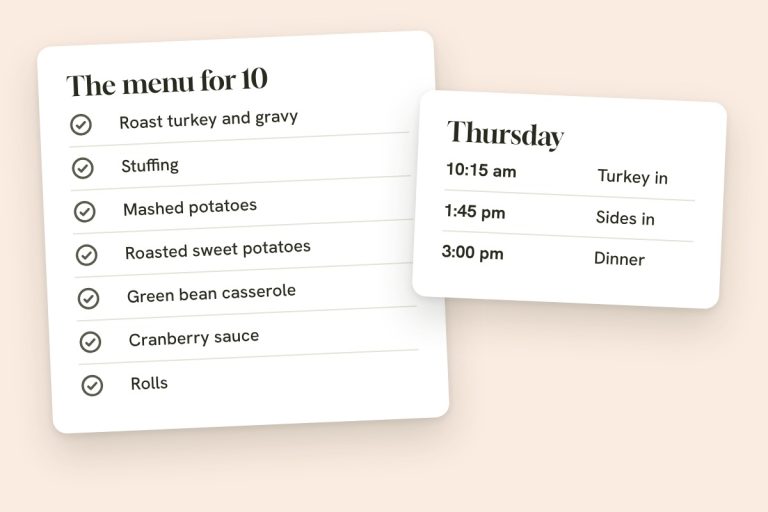
Holiday weeks need their own plan: see our Thanksgiving dinner on a budget plan, and the food line of your Christmas budget.
4. Plan one leftovers night
Put “leftovers” on the calendar for one weeknight. Everyone eats what’s in the fridge, so cooked food gets eaten before it goes bad (more on that in the at-home tips below). It’s also one night off from cooking.
5. Write the list by store section, then stick to it
Group your list the way the store is laid out: produce, meat, dairy, frozen, pantry. You walk each aisle once and you’re less likely to wander. If something isn’t on the list, it goes on next week’s.
6. Check digital coupons for things already on your list
If your store has digital coupons in its own app or on its website, clip them only for items already on your list. A “buy 5” deal on something you weren’t going to buy isn’t a saving. It’s extra spending.
7. Pick one main store
Choose 5 things you buy every week, say milk, eggs, bread, bananas and chicken. Price them at the 2 stores closest to you, online or on your next trips, and do most of your shopping at the cheaper one. One main store means one trip and one list.
8. Shop once a week, after a meal, with a time limit
Make one planned trip a week. Eat first, bring a snack for the kids, and give yourself a time limit, like 45 minutes. Every extra trip for “just milk” is another chance to pick up things you didn’t plan to buy.
At the store: 9 ways to pay less for the same food
9. Compare unit prices, not package prices
The big number on the shelf tag is the package price. The small “per oz” or “per lb” line is the unit price, and that’s the one that tells you which is cheaper.
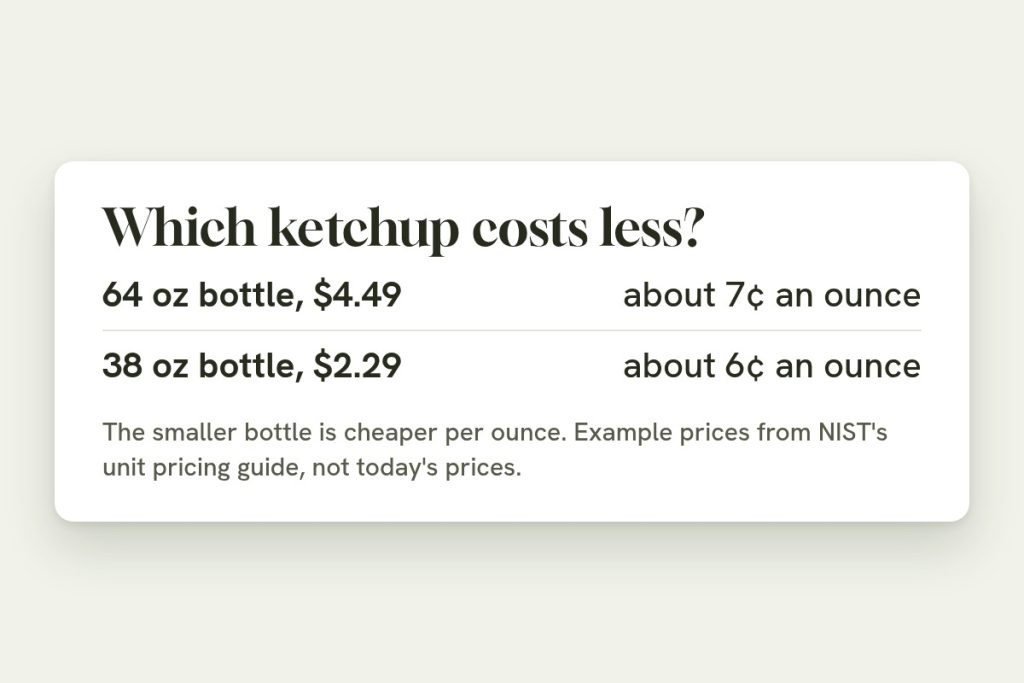
Bigger isn’t always cheaper. In an example from the National Institute of Standards and Technology (NIST), a 64 oz bottle of ketchup at $4.49 cost about 7¢ an ounce, while a 38 oz bottle at $2.29 cost about 6¢ an ounce. Those are NIST’s example prices, not today’s.
Not every state requires unit price tags: NIST counts 9 states plus DC that do (page updated February 2025). Where there’s no tag, use your phone’s calculator: price ÷ ounces.
10. Try the store brand first
Swap one name brand item a week for the store brand: flour, canned tomatoes, cereal, frozen vegetables. If nobody notices, keep the swap. If someone does, switch that one back and try the next item.
The unit price (tip 9) shows you what each swap saves.
11. Buy the whole chicken (or bone-in pieces)
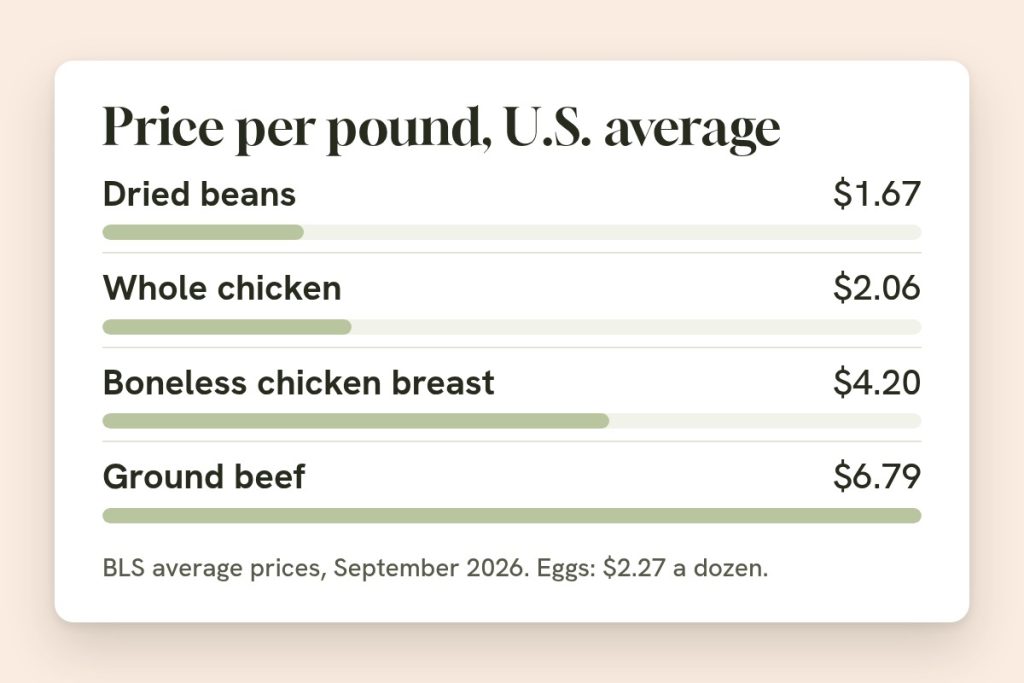
As of September 2026, U.S. average prices were $2.06 a lb for a whole chicken and $4.20 a lb for boneless chicken breast. By our math, that’s less than half the price per pound. These are BLS national averages, not your store’s shelf price.
Roast one whole chicken and use the meat for two dinners (roast chicken one night, chicken quesadillas the next). Then simmer the bones for broth.
12. Stretch ground beef with beans or lentils
Ground beef averaged $6.79 a lb in September 2026, up from $6.32 a year earlier (about 7.4% more, by our math). USDA forecasts beef and veal prices up 9.4% for 2026.
Dried beans averaged $1.67 a lb as of September 2026. The beef and bean prices are BLS national averages.
Replace a third to half of the beef with cooked beans or lentils in tacos, chili or sloppy joes.
13. Keep eggs and beans as your backup protein
Eggs are cheaper again. A dozen grade A large eggs averaged $2.27 in September 2026, down from $3.49 a year earlier (BLS national average). USDA has egg prices 23.0% lower in August 2026 than in August 2025.
Plan one egg dinner a week (breakfast for dinner, fried rice or a frittata) and one bean dinner, like bean and cheese burritos. They’re your backup when the meat in the ad isn’t a deal.
14. Buy some vegetables and fruit frozen
Buy fresh produce for the first half of the week and frozen for the second half, so nothing wilts before you get to it. Food kept at 0 °F stays safe indefinitely, according to the FDA; the freezer times on its chart are for quality only. Pour out what you need and put the bag back.
15. Buy produce in season, and check the markdown shelf
Buy the fruit and vegetables that are piled high and priced low this week, and plan around those instead of a recipe that needs something out of season. If your store has a markdown shelf for produce or meat, check it, but only buy what you’ll cook or freeze that same day.
16. Buy in bulk only what you’ll finish
Bulk makes sense for food that keeps and that your family eats every week: rice, oats, dried beans, pasta. It doesn’t make sense for a giant tub of something that goes stale before you’re halfway through. Check the unit price first, because NIST notes that stores sometimes charge extra for larger sizes.
17. Skip the convenience markup
Pre-cut fruit, shredded cheese, single-serve cups and bagged salad kits can cost more per ounce than the whole version. Compare the unit prices on the shelf tags. Buy the whole one when 5 minutes of prep is worth it to you, and the convenient one when it isn’t.
At home: waste less of the food you buy
The EPA estimates that a household of four wastes $2,913 worth of food a year, about $56 a week and roughly 11% of what it spends on food (EPA report, April 2025, at 2023 prices). That counts food wasted at home and when eating out. Meat and dairy are the biggest dollar losses: wasted meat alone comes to $133.48 a person a year.
Wasting less at home saves part of that money without changing a single item on your shopping list.
18. Know what date labels mean
Most dates on food packages are about quality, not safety. The FDA calls these dates voluntary and says “Best if Used By” means best quality: stored properly, food “should be safe, wholesome, and of good quality after the quality date.” The FDA also cites an estimate that confusion over date labels causes about 20% of consumer food waste.
So a past date alone isn’t a reason to throw food out. For how long each food keeps, use the FDA storage chart below or USDA’s FoodKeeper app. Infant formula is the exception: federal rules require a “Use By” date on it (21 CFR 107.20), so always follow that date.
19. Check your fridge and freezer temperature
Food keeps longer when it’s cold enough. The FDA says to keep the fridge at or below 40 °F and the freezer at 0 °F, and that an appliance thermometer is the best way to know. Put an inexpensive one in your fridge this week and check it the next day.
20. Freeze it before it goes bad
If you won’t cook it in time, freeze it. Raw ground meat keeps only 1 to 2 days in the fridge but 3 to 4 months in the freezer, according to the FDA storage chart. Freeze ground meat the day you buy it if dinner isn’t within 2 days, and write the date on the bag.
| Food | Fridge (40 °F or below) | Freezer (0 °F) |
|---|---|---|
| Raw ground beef, turkey or pork | 1 to 2 days | 3 to 4 months |
| Raw chicken, whole | 1 to 2 days | 1 year |
| Raw chicken pieces | 1 to 2 days | 9 months |
| Cooked meat and meat dishes (leftovers) | 3 to 4 days | 2 to 3 months |
| Fresh eggs in the shell | 3 to 5 weeks | Don’t freeze |
For hundreds of other foods, USDA’s free FoodKeeper app lists how long they keep.
21. Make an “eat this first” bin
Put one clear bin at eye level in the fridge for opened and soon-to-go food: half an onion, the last two yogurts, Tuesday’s leftovers. Snacks and lunches come from that bin first. When it’s empty, you’ve used everything up.
22. Cook once, eat twice
Double one dinner a week, like chili or a pasta bake, and freeze half for a busy night. That freezer meal is the one you eat instead of ordering takeout.
Kids, snacks and lunches
With small kids, snacks and lunch boxes are where the grocery bill quietly grows.
23. Make your own snack packs
Buy the big bag of pretzels, the big box of crackers or the large tub of yogurt, and portion it into small reusable containers on Sunday. Compare the unit price with the multipack of single servings first (tip 9), so you know what you’re saving.
24. Pack lunches from dinner
Cook a little extra at dinner and pack it for the next day’s lunch box: pasta, rice and beans, a chicken wrap.
If money is very tight, ask your school or district for a free or reduced-price meal application. USDA says you can apply any time during the school year, and children in households that get SNAP automatically qualify for free school meals.
25. Make water and milk the everyday drinks
Drinks add up. Prices for nonalcoholic beverages rose 3.8% over the 12 months to September 2026, faster than the 1.8% for groceries overall (BLS). Make water and milk the everyday drinks, and save juice boxes and soda for treats.
If you need more help with food: SNAP, WIC (for pregnant, breastfeeding and postpartum women, babies and children under 5) and Summer EBT ($120 in grocery benefits per eligible school-age child when school is out, in participating states) are run by USDA. The links explain who qualifies.
Start here tonight
Write this week’s grocery number on the weekly grocery split in our free budget printables, then check your fridge before you write the list. At the end of the week, fill in what you spent and what’s left on the same page, so you can see where your food money goes.