The month starts, the bills land one by one, and you’re working it out as you go. You’d rather sit down once, before the first, and know where it’s all going.
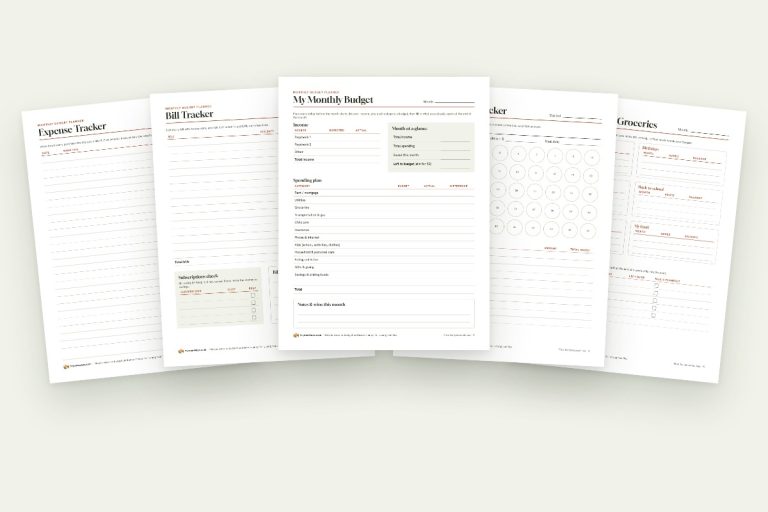
This page walks you through our free 5-page monthly budget planner in one sitting: what to gather, the order to fill in the pages, and a filled-in example month. Plan on about an hour.
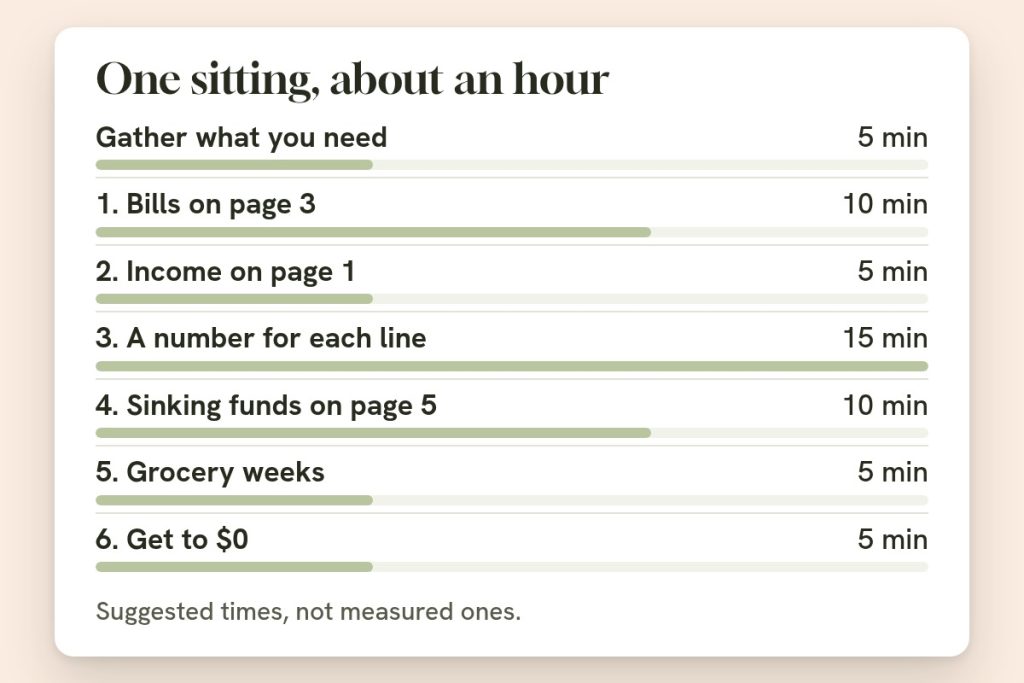
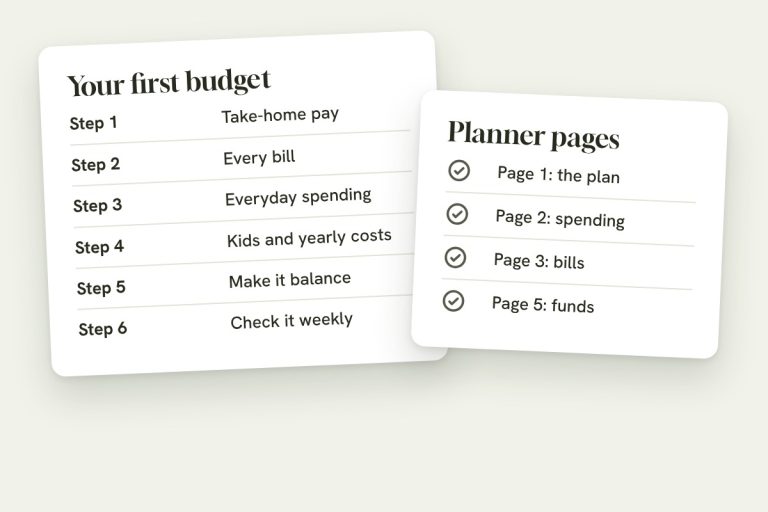
The short version: bills first (page 3), then income and the spending plan (page 1), then coming costs and groceries (page 5). Stop when “Left to budget” reads $0. Never made a budget? Start with how to budget for beginners. Want to see every page first? See every page of the set.
Before you start: what to gather (5 minutes)
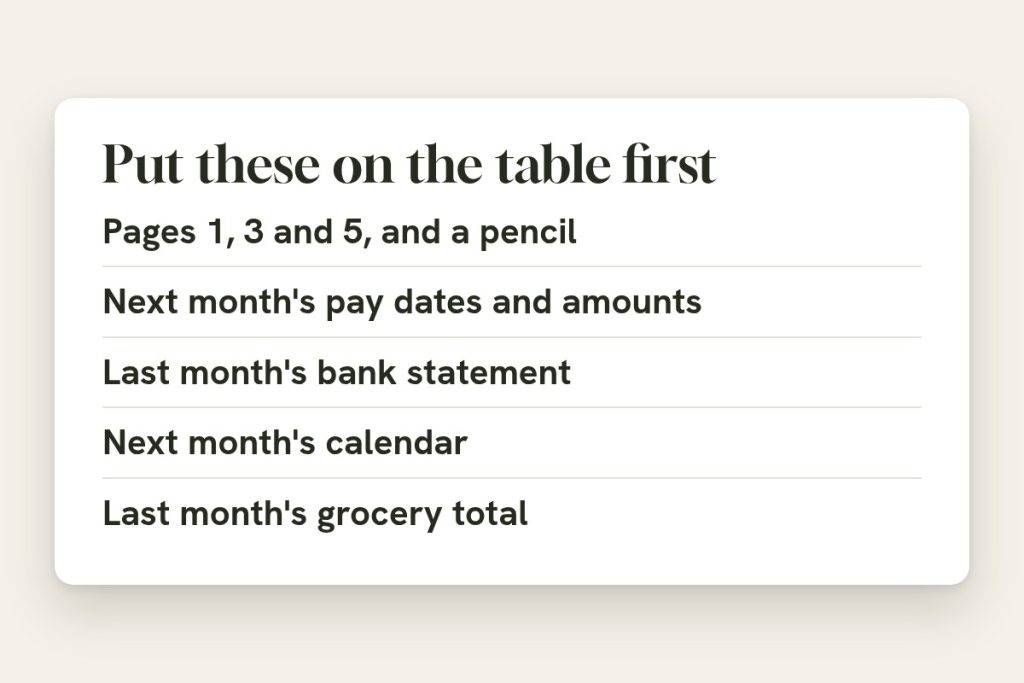
Put these on the table first, so you don’t stop halfway:
- Pages 1, 3 and 5, printed, and a pencil.
- Next month’s pay dates and take-home amounts (pay stubs help).
- Last month’s bank statement, or your banking app, to find every bill and subscription.
- Next month’s calendar: birthdays, school events, holidays, a car registration, anything that costs money.
- Last month’s grocery total, from receipts or the statement.
Keep your phone’s calculator handy: you print the planner, write on it and add up the totals yourself. No exact number for a line? Use last month’s.
The minutes in each heading are suggested times, about 55 in all.
Step 1: List every bill on page 3 (10 minutes)
Go through last month’s statement line by line and write each bill on page 3: name, due date, amount.
Bills that change (electric, gas, water) go in at last month’s amount, and also in the “Bills that change month to month” box. Subscriptions go in the subscriptions check: tick Keep, or cancel it now.
Add up the Total bills. Bills come first because you can’t move them, so page 1 starts from a real number. Keep page 3 out all month and tick each bill as you pay it.
Step 2: Write next month’s income on page 1 (5 minutes)
Use the Expected column only: Paycheck 1, Paycheck 2, and Other for any other regular money that lands in the month. Write take-home pay (what reaches your bank), only money you’re sure of, and add up Total income.
Paid every two weeks? Some months have three paychecks: write in only the ones that land this month. Leave the Actual column for the end of the month.
Step 3: Give each line on page 1 a number (15 minutes)
Fixed lines first
Copy rent, utilities, childcare, insurance, and phone and internet from page 3.
Then the flexible lines
Groceries: start from last month’s total, with USDA’s food plans as a check. Then transportation and gas, kids, household and personal care, eating out and fun, and gifts.
Check your calendar: a birthday party goes in Gifts, school pictures in Kids. Our tip: round up, not down.
The blank line
Use it for the one cost the list doesn’t cover, like a pet or a gym. A car payment you already make goes there as a fixed bill.
Step 4: Set money aside for costs you know are coming (10 minutes)
Page 5 has six fund boxes (Christmas and holidays, birthdays, car repairs, back to school, medical and dental, and one of your own). In each one that matters to you, write what you’ll add this month.
How much? The yearly cost divided by 12, or by the months left before it’s due. The funds plus your page 4 savings goal make page 1’s “Savings and sinking funds” line.
Planning November? Thanksgiving is a coming cost too: see Thanksgiving dinner on a budget. For this December, see the example below.
Step 5: Split groceries into weeks on page 5 (5 minutes)
Split page 1’s grocery number into four full weeks plus a small fifth week for the days left over, in the Budget column. Leave Spent and Left over for later.
Step 6: Fill in “Month at a glance” and get to $0 (5 minutes)
Fill in the four lines in the tinted box on page 1:
- Total income: from step 2.
- Total spending: every page 1 line except Savings and sinking funds.
- Saved this month: the Savings and sinking funds line.
- Left to budget: total income minus total spending minus saved.
Money left? Put it in savings or a fund on purpose. Short? Lower a flexible line, never a bill. Stop at $0: that’s the idea behind a zero-based budget.
Example: a filled-in monthly budget plan for a family of four
Remember the example family from our beginners guide? Here they are, setting up next month: two parents, a 2-year-old in full-day childcare and a 6-year-old in first grade, $5,000 take-home a month.
Page 3: their bills
| Bill | Amount | Where it comes from |
|---|---|---|
| Rent (utilities included) | $1,487 | Census median gross rent, rent plus utilities (as of 2024) |
| Childcare | $1,000 | Example, inside the Labor Department’s range of $546 to $1,300 a month for full-day care (as of 2022) |
| Car insurance | $172 | BLS car insurance $2,060 a year / 12 (as of 2024) |
| Phone | $115 | BLS phone $1,377 a year / 12 (as of 2024) |
| Internet | $65 | Example |
| Total bills | $2,839 |
Their “Bills that change” box says “Utilities: in the rent for now.” Pay electric, gas or water yourself? List each one there.
Page 1: their month
| Income | Expected |
|---|---|
| Paycheck 1 | $2,500 |
| Paycheck 2 | $2,500 |
| Other | $0 |
| Total income | $5,000 |
| Spending plan | Budget | Where it comes from |
|---|---|---|
| Rent / mortgage | $1,487 | Page 3 |
| Utilities | in rent | In the Census rent |
| Groceries | $955 | USDA Thrifty Food Plan, their ages, $954.50 (as of September 2026) |
| Transportation & gas | $317 | BLS gas $2,937 + car upkeep $869 a year / 12 (as of 2024) |
| Childcare | $1,000 | Page 3 |
| Insurance | $172 | Page 3 (car insurance) |
| Phone & internet | $180 | Page 3: $115 + $65 |
| Kids (school, activities, clothes) | $100 | Example |
| Household & personal care | $202 | BLS supplies $1,270 + personal care $1,157 a year / 12 (as of 2024) |
| Eating out & fun | $150 | Example |
| Gifts & giving | $50 | Example |
| Savings & sinking funds | $387 | Example: $150 funds (page 5) + $237 savings goal (page 4) |
| Total | $5,000 |
Month at a glance: income $5,000, spending $4,613, saved $387, Left to budget $0 ($5,000 minus $4,613 minus $387).
Page 5: their funds and grocery weeks
Christmas and holidays, $84. Americans expected to spend $1,007 on holiday gifts (Gallup poll, as of October 2025), and $1,007 / 12 is about $84. This fund builds next year’s Christmas: twelve months of $84 is $1,008 by next December. This year’s is too close, so plan it by the weeks left, as in our Christmas on a budget ideas.
Back to school, $66: the rest of their $150, their choice. Car repairs stays blank: car upkeep is already in Transportation and gas.
That’s $150 in funds this month ($84 + $66). The other $237 goes to their savings goal on page 4.
| Week | Budget |
|---|---|
| Week 1 | $220 |
| Week 2 | $220 |
| Week 3 | $220 |
| Week 4 | $220 |
| Week 5 (the days left) | $75 |
| Month total | $955 |
What the example shows
- Bills ($2,839) take about 57% of take-home pay before groceries. Childcare is the second biggest line.
- Health insurance comes out of their pay before take-home. If yours doesn’t, add it to Insurance.
Lines marked “Example” are this family’s own choices. The BLS lines are averages for married couples whose oldest child is under 6, a group earning $161,271 on average before taxes (as of 2024), so we used them only for gas, car upkeep, car insurance, phone and supplies.
These are one example family’s numbers, not a target. Start from your own statement and receipts.
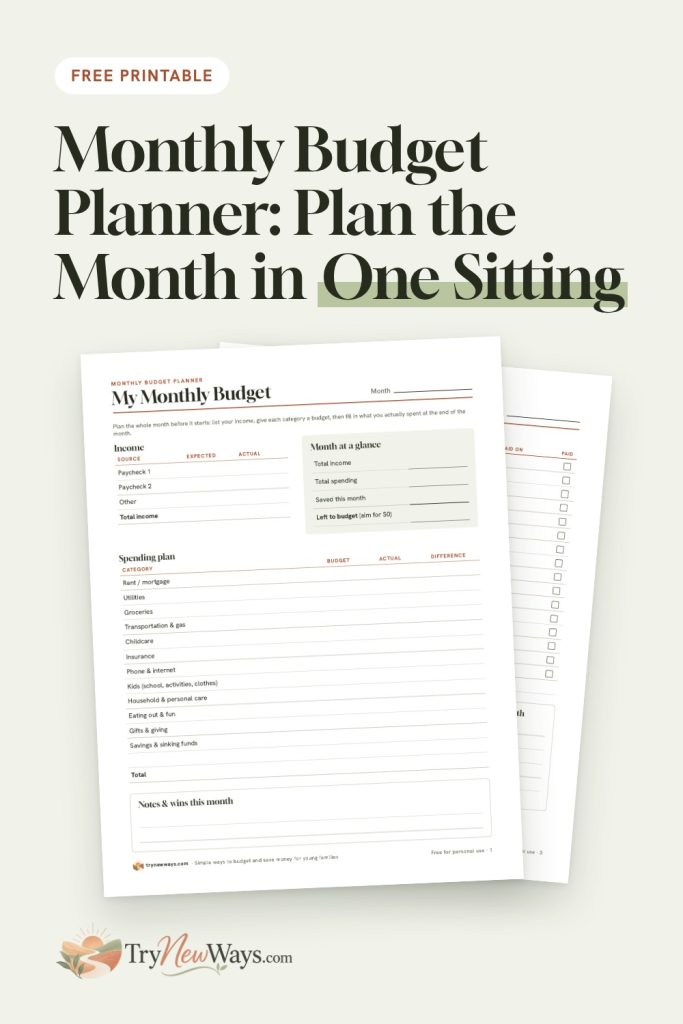
Our free monthly budget printable
Get our monthly budget printable free PDF by email from the box at the top: 5 pages on US Letter, fine in black and white, free for personal use, so print as many copies as your household needs and write on them. Every page, line by line: our free budget printables.
After the sitting: three things to keep it going
- Write each purchase on page 2, kept with page 1.
- A quick check of groceries (page 5) and spending (page 2) each week.
- Keep the pages together in one place, like a folder on the fridge.
At month end, fill in page 1’s Actual and Difference columns, and use what you learned next month.
Questions about the monthly budget template
Can I fill it in on my phone?
No. This budget planner printable is made to print and write on. Rather use a screen? Copy the same lines into a spreadsheet.
Which pages do I print each month?
Pages 1, 3 and 5 for the sitting, page 2 as you spend (extra copies if 26 lines won’t last), and page 4 once per goal.
Budgeting with a partner?
Fill in pages 3 and 1 together, so you agree on the bills before you split up the rest.
Start here tonight
Print pages 1, 3 and 5 of the free PDF, open last month’s bank statement, and write down your first bill. New to budgeting? Read our step-by-step guide to budgeting for beginners next.