“Every month the money’s gone before the next paycheck, and I don’t even know where it went.” If that sounds like your house, you’re in the right place. Most of us were never shown how to make a budget, and the examples online are usually one person with no kids, no daycare bill and no birthday parties.
This is a beginner’s guide to budgeting with a family in it. You get 6 plain steps, one example family of four worked through with real US numbers, and a free planner to write on as you go. The short answer on how to budget for beginners: write down what comes in, list what has to go out, add what the kids and the year really cost, make the two match, and check it every week.
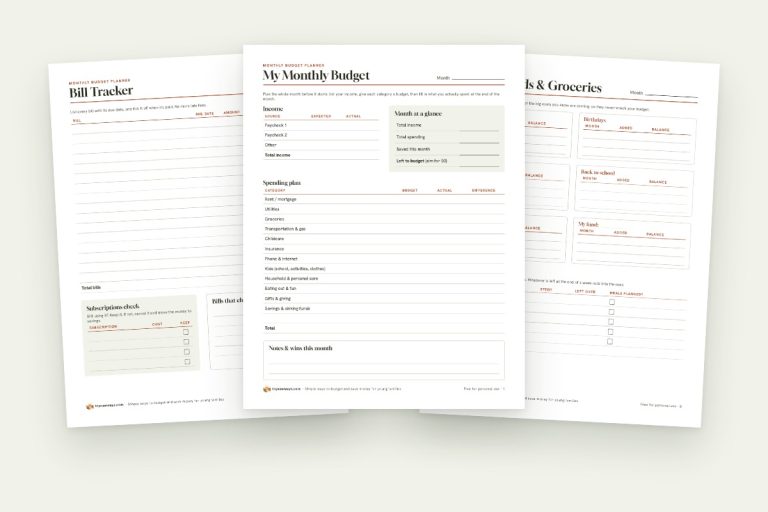
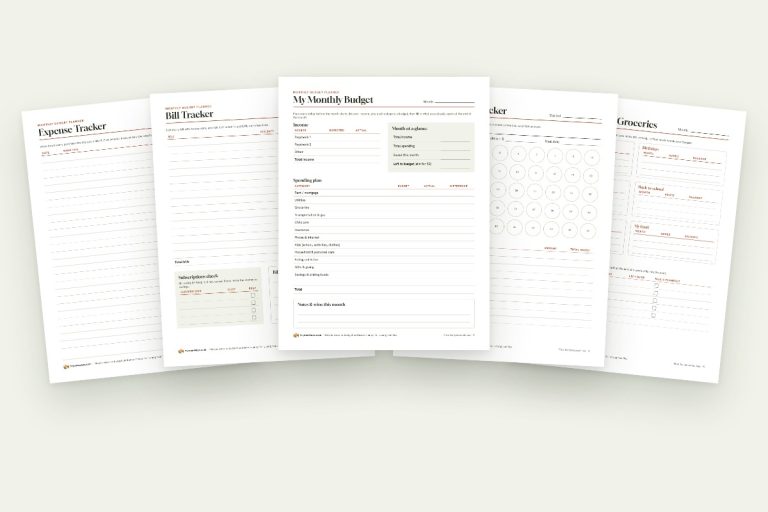
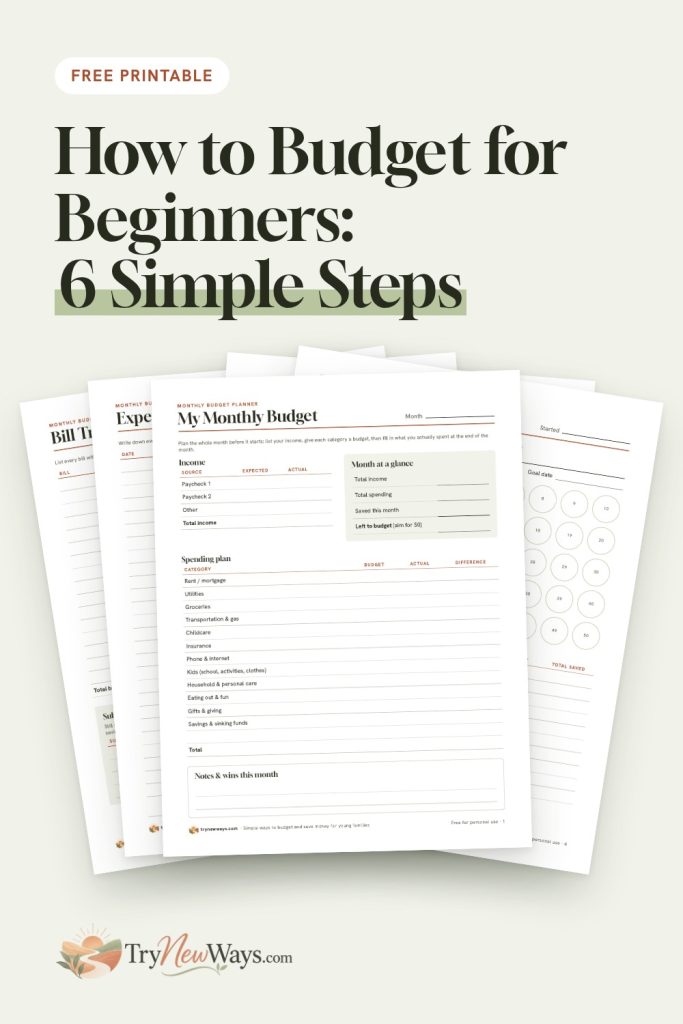
Print the planner first. It’s called the Monthly Budget Planner: 5 pages on US Letter paper, made to print and write on by hand. Enter your email in the box below and we’ll send it to you.
The 6 steps at a glance
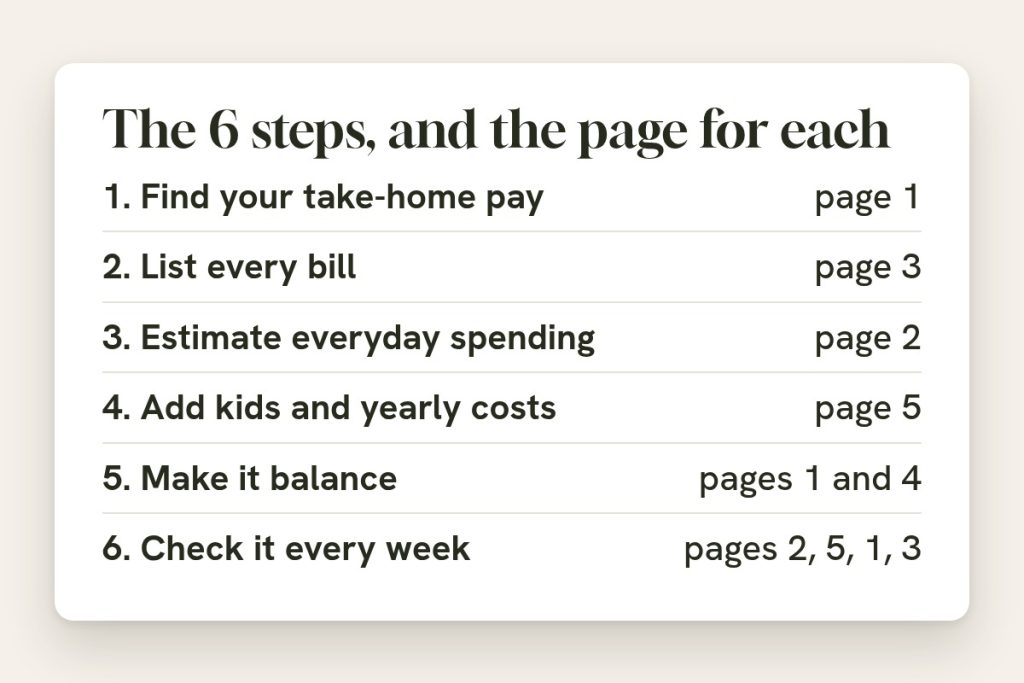
Here’s how to budget for beginners, step by step. Each step names the planner page to fill in.
- Find your take-home pay (page 1)
- List your bills (page 3)
- Estimate your everyday spending (page 2)
- Add kid costs and the costs that don’t come every month (page 5)
- Make it balance (page 1 and page 4)
- Check it every week (pages 2, 5, 1 and 3)
This guide sticks to everyday spending, bills and saving. “Savings” here means a savings account or an envelope at home, nothing more. If you’d like to see what each page of the planner is for before you start, our free budget printables post walks through all five.
Meet our example family
To show the steps with real numbers, we built one example family. They aren’t a real family, and their numbers aren’t a rule. There are two parents, a 2-year-old in full-day childcare, and a 6-year-old in first grade at public school. They rent, and both parents work.
Their take-home pay is $5,000 a month. That’s our example amount, not a statistic. For scale, a full-time worker aged 25 to 34 at the median earned $1,173 a week before taxes (Bureau of Labor Statistics, as of July to September 2026), which is about $5,083 a month. Your numbers will be different. Use theirs to see how the steps work, then use yours.
Their other numbers come from USDA food plans (as of September 2026), Census rent figures (2024), Bureau of Labor Statistics spending averages for married couples whose oldest child is under 6 (2024), and the Labor Department’s childcare prices (2022). The rent, spending and childcare figures are a few years old, so real prices are a bit higher today. Each one is linked where we use it.
One more note on those BLS averages: that group earns more on average than our example family. So we only use its numbers for costs that don’t grow much with income, like gas, car upkeep, car insurance, phone and household supplies.
Step 1: Find your take-home pay
Learning how to budget money for beginners starts here, because you can’t plan money you don’t know you have. Take-home pay is what lands in your bank account after taxes and anything else your job takes out of your paycheck, like health insurance. It’s not your salary.
Look at your last pay stubs or your bank statement and write down the amounts that actually arrived. Paid every week or every two weeks? Add up the paychecks that land this month.
On the planner: page 1, the Income box. Write each paycheck on its own line (Paycheck 1, Paycheck 2, Other) in the Expected column. You’ll fill in the Actual column at the end of the month.
Our example family: Paycheck 1 plus Paycheck 2 comes to $5,000. Their health insurance comes out of their pay before it reaches the bank, so it isn’t a line in their budget. That’s an example assumption: if you pay for health insurance yourself, add it to the Insurance line.
One parent doing this alone is completely fine. Doing it as a couple? Sit down together for this first one, so you both know the numbers.
Step 2: List every bill (the fixed costs)
Fixed costs are the bills that come every month at about the same amount: rent or mortgage, utilities, phone and internet, insurance and childcare. Write the due date next to each one, so you know which paycheck pays it.
If you have a required monthly payment, like a car payment, list it as a fixed bill.
On the planner: page 3, the Bill Tracker. Each line has a spot for the bill, its due date, the amount, the day you paid it and a box to tick. Then copy each amount onto its line in page 1’s spending plan.
While you’re on page 3, write your subscriptions in the subscriptions check: streaming, apps, memberships. Don’t cancel anything yet. You’ll decide in Step 5.
Our example family’s bills:
- Rent with utilities, $1,487. That’s the US median gross rent, which counts rent plus utilities (Census, as of 2024). So their Utilities line on page 1 just says “in rent”. On your own planner, split rent and utilities by your real bills.
- Childcare, $1,000. The Labor Department found that full-day care for one child cost $6,552 to $15,600 a year in 2022, which is $546 to $1,300 a month, depending on the child’s age, the type of care and where you live. Our example uses $1,000. Expect higher prices today.
- Car insurance, $172. Families like this spent $2,060 a year on vehicle insurance on average (BLS, as of 2024).
- Phone and internet, $180. Phone is $115, from the same BLS average for families like this ($1,377 a year on telephone services, as of 2024). Internet is $65, an example amount.
| Bill (page 1 line) | Example amount |
|---|---|
| Rent or mortgage (rent with utilities) | $1,487 |
| Utilities | in rent |
| Childcare | $1,000 |
| Insurance (car) | $172 |
| Phone and internet | $180 |
| Total bills | $2,839 |
Step 3: Estimate your everyday spending
Everyday spending is the money that changes from week to week: groceries, gas, household and personal care, eating out and fun. For a first guess, go through last month’s bank statement and receipts and add up each kind. Put those guesses in page 1’s Budget column for now.
Then check your guesses. For one month, write down every purchase on page 2, the Expense Tracker: the date, what it was for, the category and the amount. It has 26 lines, so print more copies if your family needs them.
Keep it simple and use the 12 lines already printed on page 1. If a purchase doesn’t fit one, put it on the closest line.
Our example family’s everyday spending:
- Groceries, $1,029. That’s the USDA low-cost food plan for their ages (as of September 2026): $276.30 for mom, $317.70 for dad, $173.50 for the 2-year-old and $261.50 for the 6-year-old. USDA assumes all meals and snacks are made at home.
- Transportation and gas, $317. Families like this spent $2,937 a year on gas and $869 on car maintenance and repairs on average (BLS, as of 2024). That’s $3,806 a year, or $317 a month.
- Household and personal care, $202. Same BLS group: $1,270 a year on housekeeping supplies and $1,157 on personal care products and services (as of 2024). That’s $2,427 a year, or $202 a month.
- Eating out and fun, $200. Their choice. This line is a decision, not an average to copy.
| Everyday spending (page 1 line) | Example amount |
|---|---|
| Groceries | $1,029 |
| Transportation and gas | $317 |
| Household and personal care | $202 |
| Eating out and fun | $200 |
| Total everyday spending | $1,748 |
Step 4: Add the kids and the costs that don’t come every month
Kids cost more than childcare. There are clothes and shoes they grow out of, school fees and supplies, and maybe one activity. Page 1 has its own line for this: “Kids (school, activities, clothes)”. Our example family puts $100 a month there, their choice.
Then come the costs that show up once or twice a year: Christmas, birthdays, back to school, and the car repair you can’t put a date on. These are the ones that blow up a month when they land all at once.
The fix is a sinking fund: a small amount you set aside every month for a big cost you know is coming. When the cost arrives, the money is already there, so it doesn’t wreck the month.
On the planner: page 5 has six fund boxes. Five already have names: Christmas and holidays, Birthdays, Car repairs, Back to school, and Medical and dental. The sixth is a blank “My fund”. Write a monthly amount in each one you need. Each month, write what you added and the new balance.
Planning this Christmas? Our Christmas on a budget ideas show how to set a number and stick to it. Hosting a big holiday meal is another once-a-year cost: see Thanksgiving dinner on a budget.
Our example family: $50 a month on the Gifts and giving line. Their goal for the Savings and sinking funds line is $400 a month: $150 into sinking funds and $250 into savings. All three amounts are their own choices.
| Kids and yearly costs (page 1 line) | Example amount |
|---|---|
| Kids (school, activities, clothes) | $100 |
| Gifts and giving | $50 |
| Savings and sinking funds (goal) | $400 ($150 sinking funds, $250 savings) |
Step 5: Make it balance (how to budget and save money at the same time)
Now the math: take-home pay minus every spending line on page 1. Page 1’s “Month at a glance” box has four lines for it: Total income, Total spending, Saved this month, and Left to budget (aim for $0).
Aiming for $0 left to budget means you keep planning your income into lines until none of it is unplanned. That’s the idea behind a zero-based budget.
The first draft doesn’t balance
Here’s our example family’s first draft. Their spending comes to $4,737, so $263 is left. But they wanted $400 for savings and sinking funds, so they’re $137 short.
Two changes that close most of the gap
- Groceries down to about $955. That’s the USDA Thrifty Food Plan for their ages ($954.50, as of September 2026), and it’s $74 less than the first draft.
- Eating out and fun from $200 to $150. That’s $50 less.
Together that frees $124. Spending drops to $4,613, so $387 is left for savings and sinking funds: $150 to sinking funds and $237 to savings. Left to budget: $0.
| Page 1 line | First draft | Final |
|---|---|---|
| Rent or mortgage (with utilities) | $1,487 | $1,487 |
| Utilities | in rent | in rent |
| Groceries | $1,029 | $955 |
| Transportation and gas | $317 | $317 |
| Childcare | $1,000 | $1,000 |
| Insurance | $172 | $172 |
| Phone and internet | $180 | $180 |
| Kids (school, activities, clothes) | $100 | $100 |
| Household and personal care | $202 | $202 |
| Eating out and fun | $200 | $150 |
| Gifts and giving | $50 | $50 |
| Total spending | $4,737 | $4,613 |
| Take-home pay | $5,000 | $5,000 |
| Left after spending | $263 | $387 |
| Savings and sinking funds | goal $400 ($137 short) | $387 ($150 sinking funds, $237 savings) |
| Left to budget | $137 short | $0 |
They’re $13 under their savings goal this month, and that’s fine. A first budget that’s a little short is normal. The point is that all $5,000 now has a line on page 1.
If your gap is bigger, look at page 3’s subscriptions check and your eating out and fun line first. Groceries are often the next place to look: our guide on how to save money on groceries has ways to bring that line down.
Then turn to page 4, the Savings Goal Tracker, for the one goal your savings line is building, like a starter cushion for surprises. Write the goal at the top and color in a circle each time you add to it.
Step 6: Check it every week, then redo it each month
Once a week, add up what you wrote on page 2 and fill in that week’s grocery row on page 5: budget, spent and left over. If one line is running ahead, you’ll see it while there’s still time in the month to fix it. Pick one day a week for this, like Sunday evening, so it turns into a habit.
At the end of the month, fill in page 1’s Actual and Difference columns and tick the paid bills on page 3. Then set up next month. After the first time, it takes one sitting, and our monthly budget planner guide walks you through it.
Budget tips for beginners: what trips up a first budget
- Forgetting the costs that don’t come every month. Birthdays and car repairs aren’t surprises, just irregular. Give them a sinking fund (Step 4).
- Making the fun line $0. A plan with no room for a pizza night is hard to keep. A small fun line is part of the plan.
- Guessing instead of tracking for the first month. Your first numbers are guesses. Page 2 shows where the money really went.
- Giving up when the first month doesn’t match. It almost never matches the first time. Change the lines that were off and redo it next month (Step 6).
Family budgeting works the same way on one paycheck or two. The steps don’t change, only the numbers do.
Start here tonight
Print page 1 and page 3 of the free Monthly Budget Planner. Write your take-home pay on page 1, and every bill with its due date on page 3. That’s Steps 1 and 2 done, and it’s the hardest part of how to budget your money for beginners: getting started.
Next month, set up your monthly budget in one sitting. And for a closer look at each page of the planner, see our free budget printables.