It’s late October, the first holiday ads are out, and you’re already doing the math in your head. How do we give the kids a happy Christmas this year without spending January paying for it?
Start with the money, not the gift list. Pick one number for the whole season, then split it into a few lines: gifts, food, decor, cards and travel. The 25 Christmas on a budget ideas below, for the whole family, help everything fit inside that number.
In an October 2026 survey by the National Retail Federation (NRF), 56% of shoppers said the economy will affect their holiday spending.
Start with your Christmas number (ideas 1 to 5)
These five steps take one evening, and you do them before you buy a single gift.
1. Pick one number for the whole season
Gifts, food, decor, cards, travel, outings: one total. Base it on what you can set aside by mid-December, not on last year.
It’s easier to start low than to cut later. In Gallup’s October 2025 poll, people in households earning under $50,000 planned to spend $651 on gifts. By Gallup’s November 2025 poll, that same group had cut its plan to $384. Plans often shrink as the season goes on, so pick a number you’re sure you can cover now, not one you’ll have to trim in November.
There’s no “normal” total you have to match. Counting the whole household and the whole season, Deloitte’s 2026 survey found households earning under $50,000 plan to spend about $693. Your number only has to fit your family.
If the number you can manage feels too small, pause one regular cost for a few weeks, like a streaming service or a takeout night, and move that money to your Christmas line.
2. Split it into lines before you spend a dollar
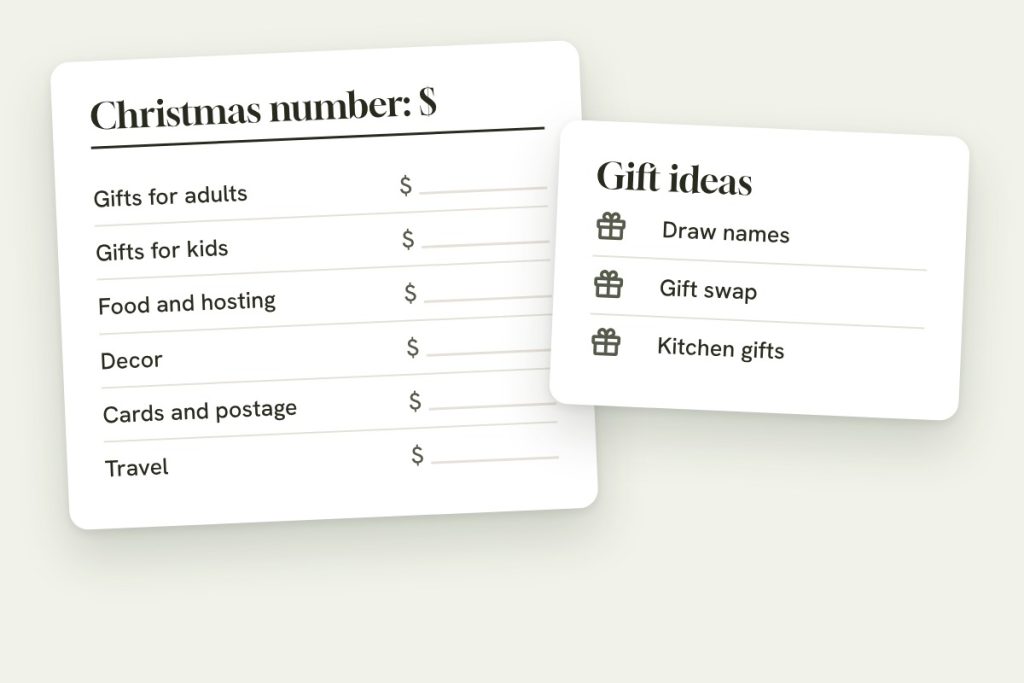
A total on its own is easy to blow through. Write your number at the top, then give each line its share:
| Line | What goes in it |
|---|---|
| Gifts for adults | Partner, parents, siblings, friends, teachers |
| Gifts for kids | Your kids, nieces and nephews |
| Food and hosting | The Christmas meal, baking, drinks for guests |
| Decor | Lights, the tree, anything new for the house |
| Cards and postage | Cards, stamps, shipping gifts |
| Travel | Gas, food on the road, a night away |
| Outings and traditions | Light displays, events, giving |
| Buffer | The thing you forgot |
Not sure how to weigh it? For reference only: in NRF’s 2025 survey, gifts made up about 70% of planned holiday spending ($627.93 of $890.49 per person), and food, decor, cards and everything else made up the rest. Your split can look completely different.
3. Turn it into a weekly amount (your Christmas sinking fund)
A sinking fund is money you set aside a little at a time for a cost you know is coming, and Christmas is a good one to start with.
Here’s an example, not a target. Say your number is $500 and you start saving the week of Nov 2. That gives you 7 weeks to Dec 20. $500 divided by 7 is $71.43, so round up to $72 a week. Use your own number and your own weeks left.
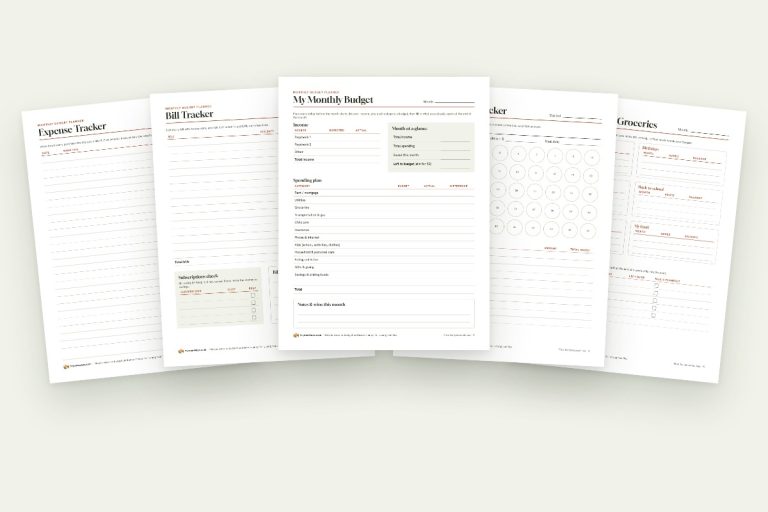
Log each deposit as you go. The sinking funds page in our free budget printables already has a Christmas & holidays box.
4. Write the who-gets-what list with a cap per person
List everyone you buy for. Next to each name, write a dollar cap. Add up the caps and check the total against your gift lines.
If the total is over, trim now, on paper. Lower a cap, move someone into a name draw (idea 6), or turn three small gifts into one group gift. This list keeps the grown-up gifts in check. The kids go on it too (see idea 13).
5. Choose your shopping weeks and track as you go
Plenty of families are already shopping. NRF’s October 2026 survey found 43% of shoppers start before November, and half of those early starters do it to spread out their budget. Still, 64% expect to do most of their shopping over Thanksgiving weekend.
Early shopping has a catch. Deloitte’s 2026 survey found shoppers expect to have spent 28% of their holiday budget by the end of October, the highest in six years. Early is fine, but only if you write down every purchase.
Pick two or three shopping weeks, put them on the calendar, and log each buy against its line. The free Christmas Budget Planner below has a Spent column for every line and a December calendar for your shopping weeks.
Gifts for the whole family (ideas 6 to 13)
Gifts are the biggest line, so start here. Bring these up in October or early November, before anyone has shopped.
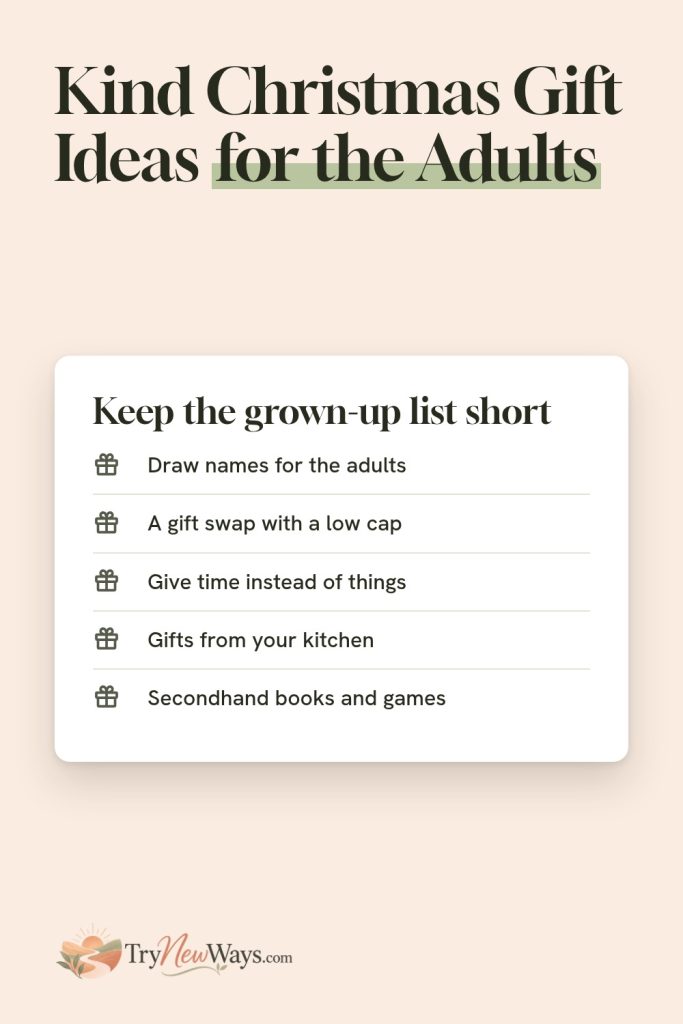
6. Draw names for the adults
Each adult draws one name and buys one gift under one cap. Draw slips of paper at a family dinner or use a free online name picker.
Want to suggest it? Here’s a text you can copy and change:
“Hi everyone! Prices are up for all of us this year. Want to draw names for the adults, one gift each, with a cap of [your amount]? I’m happy to organize the draw.”
7. Play a gift swap game with a low cap
A white elephant swap turns gifts into the evening’s entertainment. Everyone brings one wrapped gift under the cap (or something good from home), draws numbers, then picks or steals in turn.
You buy one gift instead of five. Set the cap and the rules in the group chat a few weeks ahead.
8. Suggest “kids only” gifts between households
When families get together, the adults agree to skip each other and buy only for the kids.
Say it early and kindly, and make it about everyone’s budget, not just yours: “We’d love to keep gifts for the kids this year. Would that work for you?”
9. Give time instead of things
Babysitting for a night, a home-cooked dinner, a day helping with a project: write it on a card as a coupon with a date to book it. Deloitte’s 2026 survey found 50% of shoppers plan to give an experience this year, up from 47% in 2025.
10. Make gifts from your kitchen
Cookies, granola, hot cocoa mix or a spice blend in a jar make warm gifts for neighbors and teachers.

Choose recipes built on cheaper staples. USDA’s Economic Research Service reports egg prices in August 2026 were 23% lower than a year earlier, while sugar and sweets are forecast to rise faster than usual in 2026. So go easy on candy-heavy recipes and lean on oats, flour and eggs.
11. Shop secondhand for books, games and puzzles
Secondhand gifts are now a normal choice. In NRF’s November 2025 survey, 59% of shoppers said they would consider giving a secondhand gift, and books and other media were the top pick.
Check thrift stores, library book sales and Facebook Marketplace for books, board games and puzzles. Open the box and count the pieces before you pay.
12. Give gift cards only inside your cap
Gift cards top wish lists: 47% of people in NRF’s 2026 survey said they want one. So a card for your cap amount is a gift people say they want.
Keep the receipt with the card in case it gets lost.
13. Kids’ gifts: give them their own number
Kids’ gifts already have their own line from idea 2, so they come out of the same Christmas number as everything else. Decide that number before you start browsing toys, then add each child to your who-gets-what list from idea 4 with a cap, like everyone else.
Several ideas above work for kids too: secondhand books, games and puzzles (idea 11), or a coupon for time together (idea 9).
Christmas food and hosting for less (ideas 14 to 18)
Food is easy to leave off a Christmas budget. USDA forecasts that grocery prices (food at home) will rise 2.4% in 2026 (USDA ERS), and beef is rising fastest, so start with the main dish.
14. Build the meal around ham or poultry, not beef
This is the year to skip the beef roast. USDA’s 2026 forecast has beef and veal prices up 9.4%, compared with pork up 1.2% and poultry up 1.0%. A ham, a turkey or a couple of roast chickens keeps your main dish away from the fastest-rising prices.
Watch your store’s weekly ad for the two weeks before Christmas, and buy your main dish when it’s on sale.
15. Make it a potluck
The host makes the main dish, and everyone else signs up for one item: a side, rolls, a dessert or drinks. A shared list in the group chat stops you ending up with four pies and no potatoes.
16. Host brunch instead of dinner
A Christmas brunch can feel just as festive as a big dinner. Eggs, pancakes, a baked breakfast casserole, fruit and coffee feed a crowd for one cheaper meal.
Eggs are a good bet this year: they cost far less than they did last year, according to USDA ERS.
17. Swap cookies instead of baking every kind
Baking six kinds of cookies means buying six sets of ingredients. In a cookie swap, each person bakes one big batch of one kind, and everyone goes home with a mixed box.
You shop for one ingredient list and still get a full cookie tray.
18. Take turns hosting and split the costs
Hosting every year gets expensive. Take turns: host this year, travel next year. Or split it: the host provides the house and the main dish, and guests chip in for the groceries.
For a full menu, shopping list and cooking timeline method, our Thanksgiving dinner on a budget guide works for Christmas too.
Christmas on a budget: decor and cards (ideas 19 to 21)
Decor and cards are small lines, which makes them easy to overspend without noticing.

19. Decorate from your storage bins first
Before you buy a single ornament, unpack everything you already own and see what’s really missing.
Give decor its own small line and stick to it. Pinecones, greenery from the yard and paper chains the kids make cost little or nothing.
20. Get the tree for less
The cheapest tree is the one already in your garage. If your artificial tree still stands up straight, use it another year.
If you live near a national forest, a cut-your-own tree permit can turn the tree into a family outing. Permits are sold through Recreation.gov, and each forest sets its own price, dates and rules, so check yours before you go.
21. Send postcards or a digital card, and mail on time
As of October 2026, a postcard stamp is $0.65 and a 1 oz letter stamp is $0.82 (USPS Notice 123). That’s $0.17 less per card, so 25 postcards would save $4.25 on postage (an example; use your own card count). A digital card skips postage completely.
Mail on time so you never pay for faster shipping. USPS recommends sending First-Class Mail by Thursday, Dec. 17 for delivery by Christmas in the lower 48 (USPS holiday shipping dates).
Family traditions that cost little or nothing (ideas 22 and 23)
22. Put a few free December outings on the calendar
Put two or three free things on the calendar now, so December feels full without the spending. Check your library’s and your town’s December event calendars, and plan an evening walk or drive to see the neighborhood lights.
Write them next to your shopping weeks, so the whole month sits on one page.
23. Give together
Volunteer as a family, drop a bag of canned food at your local food pantry, or add one item to a toy drive. Pick one together, put it on the calendar next to your outings, and let the kids choose what to give.
Call ahead or check the pantry’s website first: many list the items they need most, so your bag goes further.
Christmas travel on a budget (ideas 24 and 25)
Getting to Grandma’s is a real cost, and it belongs on your sheet like any gift. AAA’s 2025 year-end forecast found 89% of holiday travelers went by car, so for most families the travel line is mostly gas.
24. Price the drive with today’s gas price before you commit
As of Oct 21, 2026, AAA’s national average for regular gas is $4.26 a gallon, up from $3.05 a year earlier.
Here’s an example: a 300-mile round trip in a car that gets 25 miles per gallon uses 12 gallons. That’s about $51 at today’s price, compared with about $37 a year ago. Use your own miles and mpg, and check the price again the week you go.
Share rides where you can, pack food and drinks for the road, and put the total on your travel line.
25. Ship gifts ahead instead of packing them
Wrapped gifts take up a lot of room in the car. Order online and have gifts shipped straight to the host’s address, or mail them yourself by the USPS 2026 send-by dates for delivery by Christmas in the lower 48:
- USPS Ground Advantage: Thursday, Dec. 17
- Priority Mail: Friday, Dec. 18
- Priority Mail Express: Saturday, Dec. 19
Start here tonight
Write down your one Christmas number and divide it by the weeks left until Dec 20. That’s your weekly amount.
Then write it in the Christmas & holidays box on the sinking funds page of our free budget printables, and log each deposit until Dec 20.